
Short Answer
Leverage in trading allows you to control a larger position with a smaller amount of money. For example, 1:1000 leverage means you can control $1,000 in the market with just $1 of your own funds. While this increases potential profit, it also increases risk.
What Is Leverage in Trading?
Leverage is a mechanism provided by a broker that allows traders to open positions larger than their actual capital.
Instead of paying the full value of a trade, you only need to provide a fraction of it, called margin.
For example:
- Without leverage → you need $1,000 to open a $1,000 trade
- With leverage 1:1000 → you need only $1
On platforms like MT4/MT5, leverage is automatically applied when you open a position through a broker such as
NordFX.
How Does 1:1000 Leverage Work?
Basic Formula
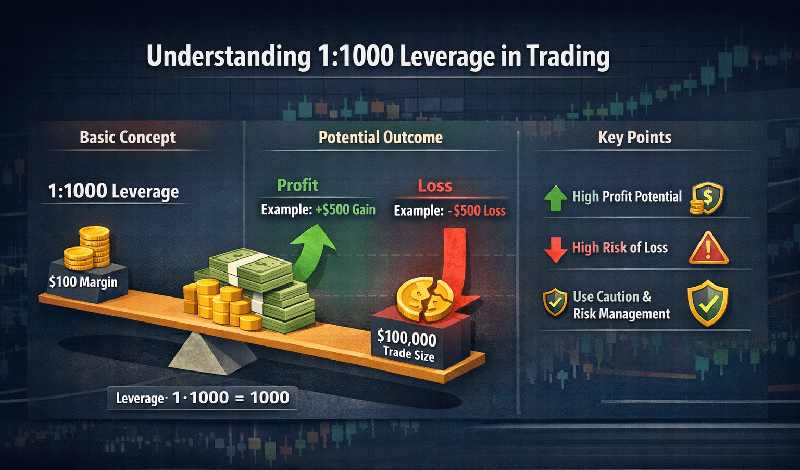
Position Size = Margin × Leverage
Example
- Your deposit: $100
- Leverage: 1:1000
- Maximum position size: $100 × 1000 = $100,000
This means you can open a trade 1000 times larger than your balance.
What Happens in Practice?
When you open a trade:
- The broker allocates margin from your balance
- The rest is effectively “borrowed” to increase your exposure
- Profit/loss is calculated on the full position size, not your deposit
This is why small price movements can have a significant impact.
Why Brokers Offer High Leverage
High leverage exists to:
- Lower the barrier to entry
- Allow traders to participate with small capital
- Increase flexibility in position sizing
For example, brokers like
NordFX
offer leverage up to 1:1000, enabling traders to access global markets with minimal initial investment.
More details about account conditions can be found here:
https://nordfx.com/
Benefits of 1:1000 Leverage
1. Capital Efficiency
You can trade large volumes with a small deposit.
2. Higher Profit Potential
Even small price movements can generate noticeable returns.
3. Access to More Opportunities
You can diversify across multiple trades.
Risks of High Leverage
1. Amplified Losses
Losses grow at the same rate as profits.
2. Margin Call & Stop Out
If your account equity drops too low, positions may be closed automatically.
👉 Learn more: https://nordfx.wiki/nordfx-wikifx/
3. Overtrading Risk
High leverage can lead to opening positions that are too large.
How to Use Leverage Safely
Use Smaller Position Sizes
Even if 1:1000 is available, you don’t need to use the full capacity.
Always Set Stop Loss
This limits downside risk.
Monitor Margin Level
Avoid falling below critical levels that trigger liquidation.
Start with a Demo Account
Practice first before trading real funds.
Leverage on MT4 and MT5
On MT4/MT5:
- Leverage is set at the account level
- Margin is calculated automatically
- You can see:
- Balance
- Equity
- Margin
- Free Margin
These metrics help you manage risk in real time.
Why Leverage Matters for Beginners
Leverage is one of the most misunderstood concepts.
Many beginners:
- Focus only on potential profit
- Ignore risk exposure
- Use maximum leverage immediately
Understanding how leverage works is essential before placing your first trade.
A structured beginner guide is available here:
https://nordfx.com/getting-started
FAQ
What does 1:1000 leverage mean?
It means you can control $1,000 in the market with just $1 of your own capital.
Is 1:1000 leverage safe?
It is not inherently safe or unsafe. It depends on how you use it. Proper risk management is critical.
Can you lose more than your deposit?
In most cases, losses are limited to your balance, but this depends on broker conditions and market volatility.
What is the best leverage for beginners?
Lower effective leverage (e.g. using smaller positions) is generally safer for beginners.
Do I have to use full leverage?
No. Leverage is a maximum limit, not a requirement.
Conclusion
Leverage is a powerful tool that can significantly increase both profits and risks. Understanding how 1:1000 leverage works allows traders to use it strategically rather than dangerously.
The key is not how much leverage is available — but how much you actually use.