
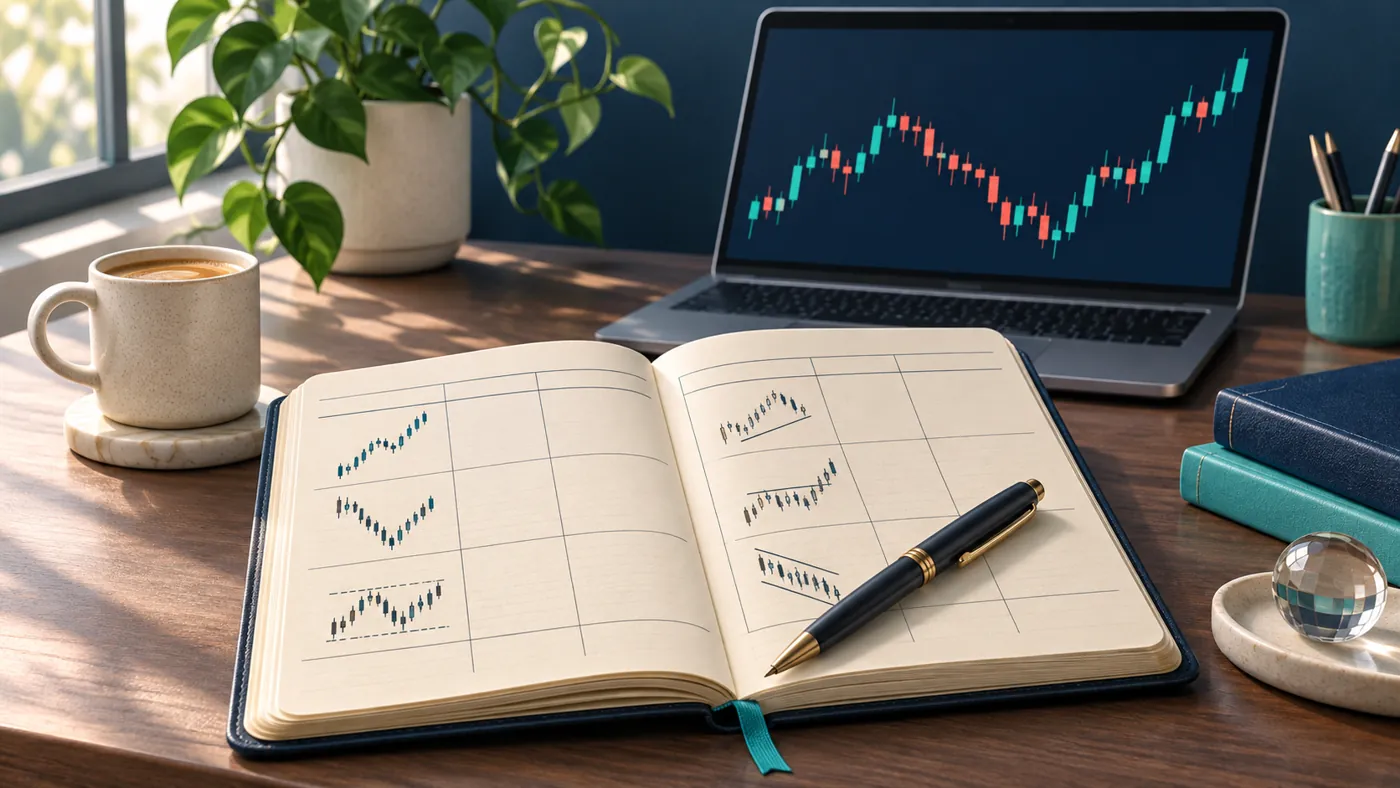
A trading history can tell you where a position opened and how much it made or lost. It usually cannot tell you why you entered, what you expected or whether you followed your own rules. A trading journal adds that missing context.
The useful habit is to record decisions while the information is still fresh, then compare those decisions with the outcome. You do not need expensive software. A spreadsheet, a folder of screenshots and a short review routine can provide a workable starting point.
Give each record a clear purpose
Build the journal around questions you want to answer. Did the entry meet your stated conditions? Was the position the size you intended? Did you change the exit plan, and why?
A journal cannot establish that a strategy will make money. It can expose missing information and repeated departures from a plan. The overview of keeping a trading journal describes how trade details, market context and decision notes fit together.
What to record before entering
Write a brief plan before placing the order. Include the instrument, direction, setup and conditions that would invalidate the idea. Specify the intended entry, initial stop, target or other exit rule, and position size.
Record planned monetary risk using the relevant contract specification and stop distance. Label this as an estimate. A standard stop loss does not guarantee an exact maximum loss because gaps and slippage can affect execution.
This compact structure keeps the original plan visible alongside what actually happened:
| Field | What it helps you check |
|---|---|
| Date, time and time zone | When the decision occurred and which market conditions applied. |
| Symbol, direction and size | The exposure you intended to take. |
| Setup and entry condition | Whether the trade met a defined rule. |
| Initial stop, exit plan and planned risk | The assumptions made before the outcome was known. |
| Actual fills, costs and net result | What execution and account records confirm. |
| Changes and review notes | How management differed from the original plan. |
Use consistent setup names. Calling the same approach “breakout” one day and “momentum entry” the next makes filtering unreliable. Add a strategy version if its rules change.
Record execution without rewriting the plan
After an order executes, add the actual time, price and filled volume. Keep the original values. If a pending order expires or is cancelled without filling, label it accordingly instead of counting it as a completed trade.
Order type belongs in the record too. The guide to market and pending orders explains why submission, triggering and execution are different events.
For partial exits, retain the individual fills and connect them to the same trading idea. Decide whether your summary counts complete positions or individual deals, then use that convention consistently. Otherwise, one position closed in three parts could distort your trade count.
Keep results and costs consistent
Reconcile the journal with the account statement. Record commissions, fees and signed swap amounts where applicable, and confirm whether the exported profit figure already includes them. Spread and slippage affect execution prices, so subtracting them again from a result calculated from actual fills can double-count their effect.
Keep deposits, withdrawals and transfers separate from trading performance. An increased account balance may reflect added funds. The explanation of trading profit and its components provides context for separating realised results, open-position changes and costs.
For a hypothetical example, suppose the initial planned risk was $20 and the completed trade produced $30 net profit. Using initial planned risk as the denominator, the result is +1.5R. A $24 net loss would be −1.2R. Here, R is a record-keeping unit, not a guaranteed loss limit.
Preserve the initial risk figure even if you later move the stop. Changing the denominator after the outcome would make comparisons misleading.
Add context that you can verify
Save an entry screenshot with the timeframe and relevant price levels visible. Add a second image after closing if it explains an exit decision. Avoid filling the folder with nearly identical screenshots.
Note scheduled announcements, observed spreads and the trading session. The article on how trading sessions affect liquidity and spreads explains why the time of day can matter.
Emotional notes should describe behaviour. “I increased size after a loss” is easier to review than “I was undisciplined.” Keep explanations tentative: a loss occurring near a news release does not, by itself, prove that the release caused it.
Review decisions as well as outcomes
At a regular review, first check for missing entries and reconcile totals. Then compare trades taken within your rules with those taken outside them. A profitable rule violation still deserves examination; a losing trade that followed the plan is not automatically an execution mistake.
Look at net results, average wins and losses, and the number of observations behind each figure. In a hypothetical ten-trade sample, six gains of $10 and four losses of $20 produce a $20 loss despite a 60% win rate.
Small samples can suggest questions, but they do not establish reliable forecasts. Avoid repeatedly changing rules to explain each recent loss. Record a proposed adjustment and its date so later observations remain distinguishable from earlier ones.
Include sessions when you chose not to trade. Note whether conditions were absent, an opportunity was missed or a practical constraint prevented participation. The discussion of evaluating one market versus several shows why these observations can matter when reviewing your trading workload.
FAQs
Is a spreadsheet enough?
Yes. Start with fields you can maintain consistently. More elaborate software is useful only if its features answer questions your existing records cannot.
When should I update the journal?
Record the plan before entry, execution details after fills, and review notes after closing. Mark anything reconstructed later so it is not mistaken for a contemporaneous observation.
Should I record losing trades?
Record every completed trade. Omitting losses, mistakes or inconvenient examples changes the sample and makes performance summaries unreliable.
Can I combine demo and live results?
Keep them separately labelled. Execution conditions and decision-making may differ, so a combined total can hide differences that you need to understand.
Will a journal make trading profitable?
No. It supports more accurate review and can reveal recurring mistakes, but it cannot remove market risk or guarantee that an approach will work.